
- In the Scribblings section of the website you will find personal notes, in which I explore my understanding and appreciation of Anhua Dark Tea.
- Entries:Feeling and sensation in tea/ Calm and energy in tea / Smokiness in Anhua Dark Tea/ The recent evolution of Fu Brick Tea/ My tea storing experiences / Outdoor tea / My view on aged tea / Qixing Stove, the tool that gives Anhua Dark Tea its soul / What is tea? A very personal question / Beyond Tianjian (many grades of tea tips)
Beyond Tianjian (many grades of tea tips)
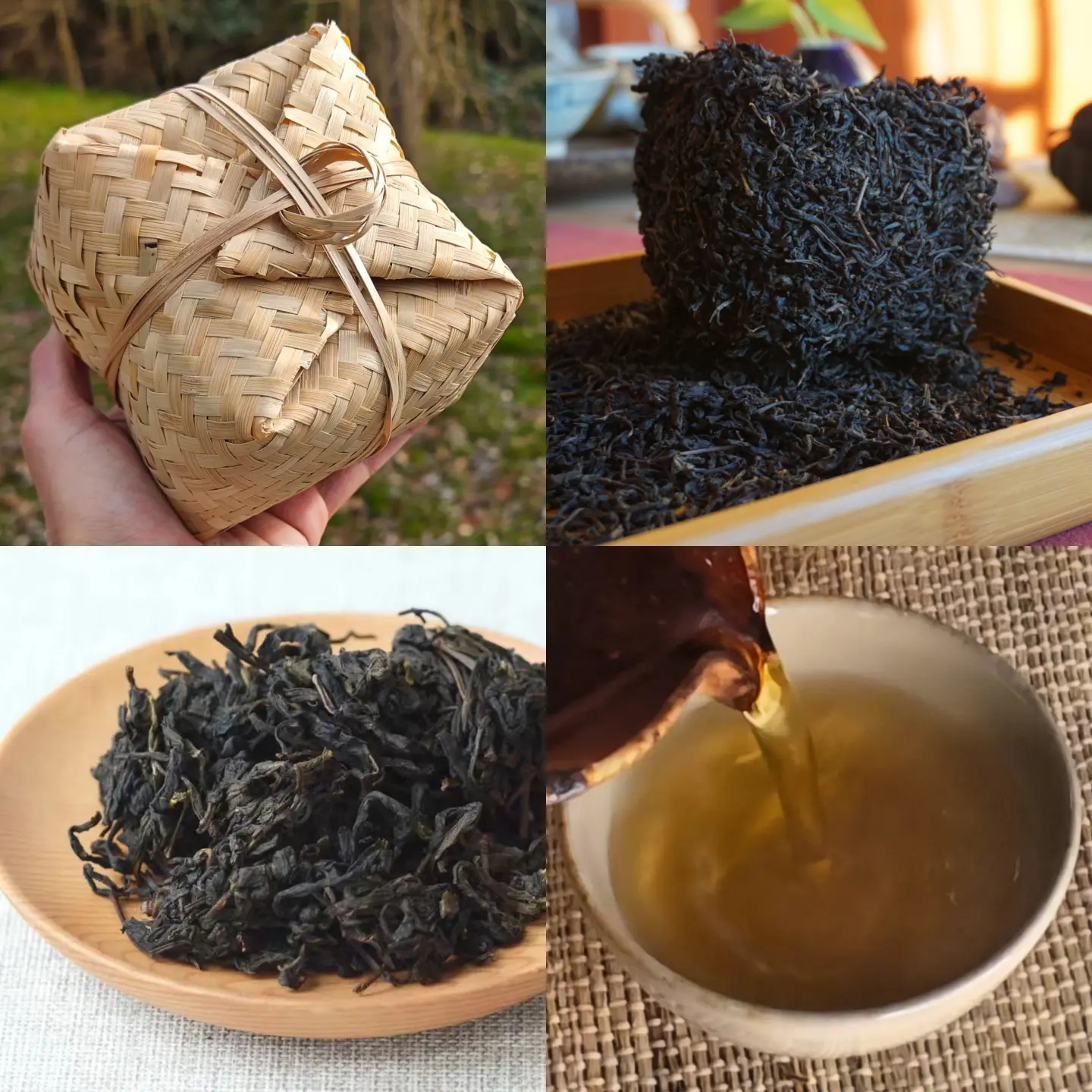
A precious gift
Tea tips processed the Anhua way and lightly compressed into bamboo baskets are one of the multiple variations of Anhua Dark Tea. They are most often referred to as Tianjian Tea (天尖茶), which can be translated as ‘Heavenly Tips Tea’.
While other variations of Anhua Dark Tea, produced with bigger leaves, were historically mostly transported into northwestern China, these more ‘delicate’ tips were prized gifts exchanged among the more wealthy drinkers. They were therefore also dispatched into the capital.
The name for the most well-known grade of tea tips from Anhua County, Tianjian, quite naturally also became the designation for this Anhua Dark Tea variation made with tea tips. There is however an even more precise classification of tippy leaves used by Anhua producers:
With multiple tiers
- Yajian (雅尖) or ‘Elegant Tips’ is a grade I have only heard a couple of producers use for the very smallest tips, similar in size to those used for the tippiest green teas.
- Chunjian (春尖) or ‘Spring Tips’ is a more recent grade used by some producers to designate the first tips picked in early spring.
- Tianjian (天尖) or ‘Heavenly Tips’ is nowadays the most common grade for tippy leaves from Anhua County.
- Gongjian (贡尖) or’ Tribute / Gift Tips’ is used for tea tips that are slightly bigger than usual for Tianjian grade.
- Shengjian (生尖) can be translated as ‘Tips for Everyone’. They are the bigger tips that were not used for gifting.
What is tea? A very personal question

‘Just a good thing’
‘Tea is just a good thing we have here on our mountain.’ This phrase, told to me years ago by a small producer from Anhua County has always stuck with me.
What I personally like in this remark is its conscious understatement. I have spent several days with this person, tasting, comparing and contrasting teas until late in the evening. I know that tea matters a lot to him, both as a way of life and as his way of making a living.
By downplaying the role that tea plays for him, he voluntarily pushed back against opposite views, which put tea front and center as a ceremonial performance, a chic tasting experience, or even as conduit to wisdom and illumination.
Or whatever you make of it …
Tea is what you make of it. There is no absolute right or wrong, when it comes to the meaning of tea. Personally, I like the more relaxed and down-to-earth approach of my friend, but this is just a subjective opinion.
It is, however, certainly not a coincidence that this way of looking at tea has led me to a preference for Anhua Dark Tea. It is an old tea that has managed to maintain a low profile, while so many others have had their period of being trendy (Let’s keep it like that!).
There are hundreds of tea sorts, originating from many different regions, each having their own character, lending to a specific way of appreciating and understanding them. While some teas are fragrant like flowers, Anhua Dark Tea’s grounded notes of pine resin appeal to those looking for a more reflective, less spectacular appreciation of tea.
Qixing stove, the tool that gives Anhua Dark Tea its soul
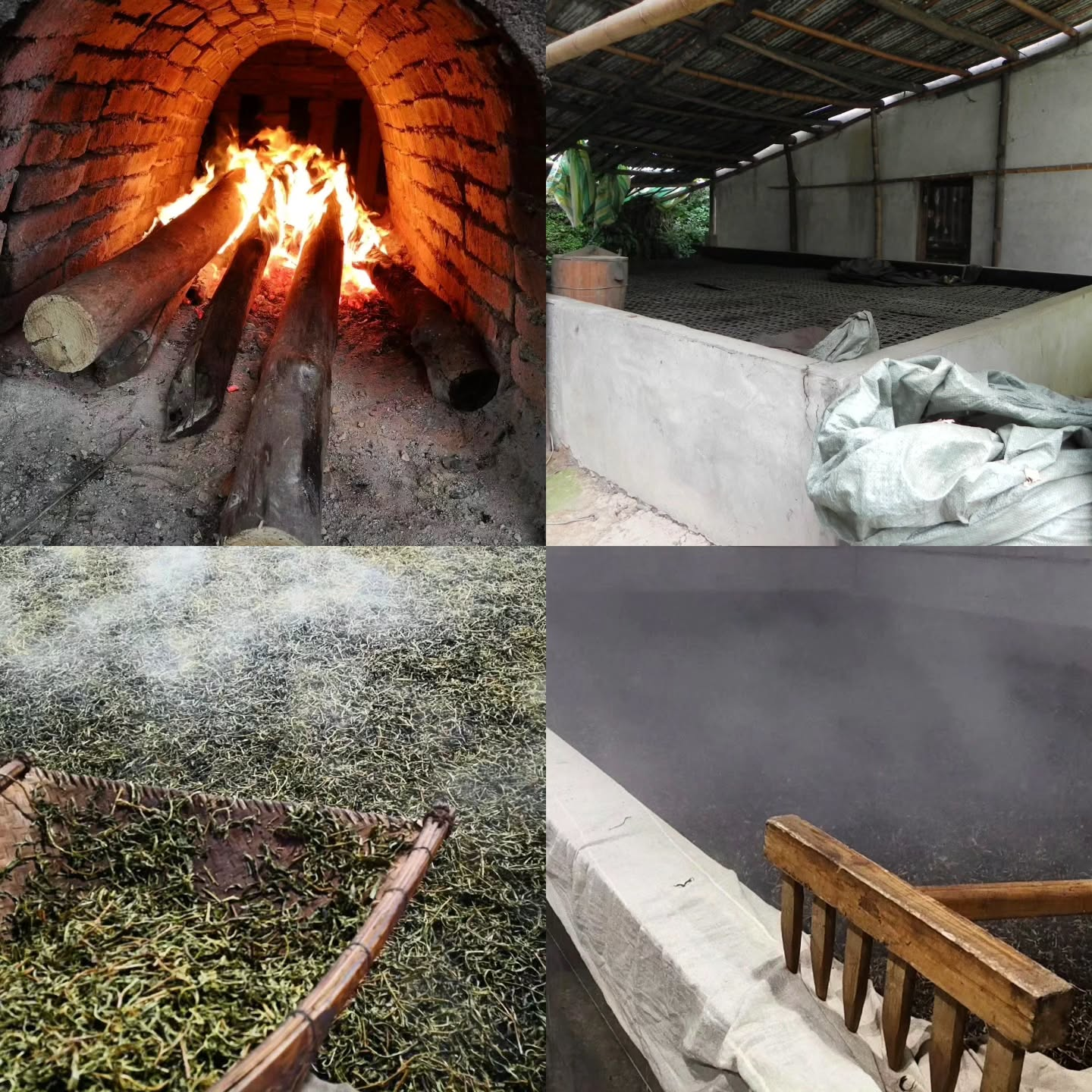
The secret behind Anhua Dark Tea’s taste and feeling
While Anhua Dark Tea requires many processing steps, none is as defining as the qixing stove (七星灶) sequence. It is unique to Anhua Dark Tea and all its variations go through it.
A qixing stove is made of three parts. In the fire pit (1), local pine wood is lit. It is a closed area and sits at one of the extremities of the stove. Holes placed at regular intervals lead the hot air into a large rectangular smoke pit (2), on top of which lies the drying / smoking surface (3), covered with a mat of woven bamboo and a natural linen.
After their light pile-fermentation, the moist tea leaves are kneaded for a second time, which makes them release some water. This is when the qixing stove comes into play. More than just a drying mechanism, it further transforms the leaves and confers to them Anhua Dark Tea’s unique character.
It is on the qixing stove that the alchemy of Anhua Dark Tea takes place. The tea leaves receive their exclusive taste in the coming together of three elements: the leaves’ own essence, the scent of the woven bamboo mat on which they are laid, and the heat and smoke of the pine wood fire.
More than just a tool
Traditionally, both the qixing stove itself and its use were associated with mystical connotations and practices. It is said that it is under the influence of the celestial bodies, and that within it, heaven and earth are blended into the tea leaves, giving Anhua Dark Tea its soul. Its use was reserved for auspicious days.
Qixing literally means seven stars. On the one hand, it refers to the fact that most stoves’ fire pits have seven holes. It is also a direct allusion to the seven stars of the Big Dipper, which plays a central role in Daoism. While its actual shape and appearance is the result of incremental improvements, It can be traced back at least to the Ming Dynasty.
Qixing stoves can be found in tea producing villages as well as in factories. Even the big factories that have a mostly automatized production will maintain a qixing stove for at least some of their products. The simple reason is that tea lovers in Anhua County will tell you that leaves that have not been on a qixing stove cannot be called Anhua Dark Tea.
My view on aged tea
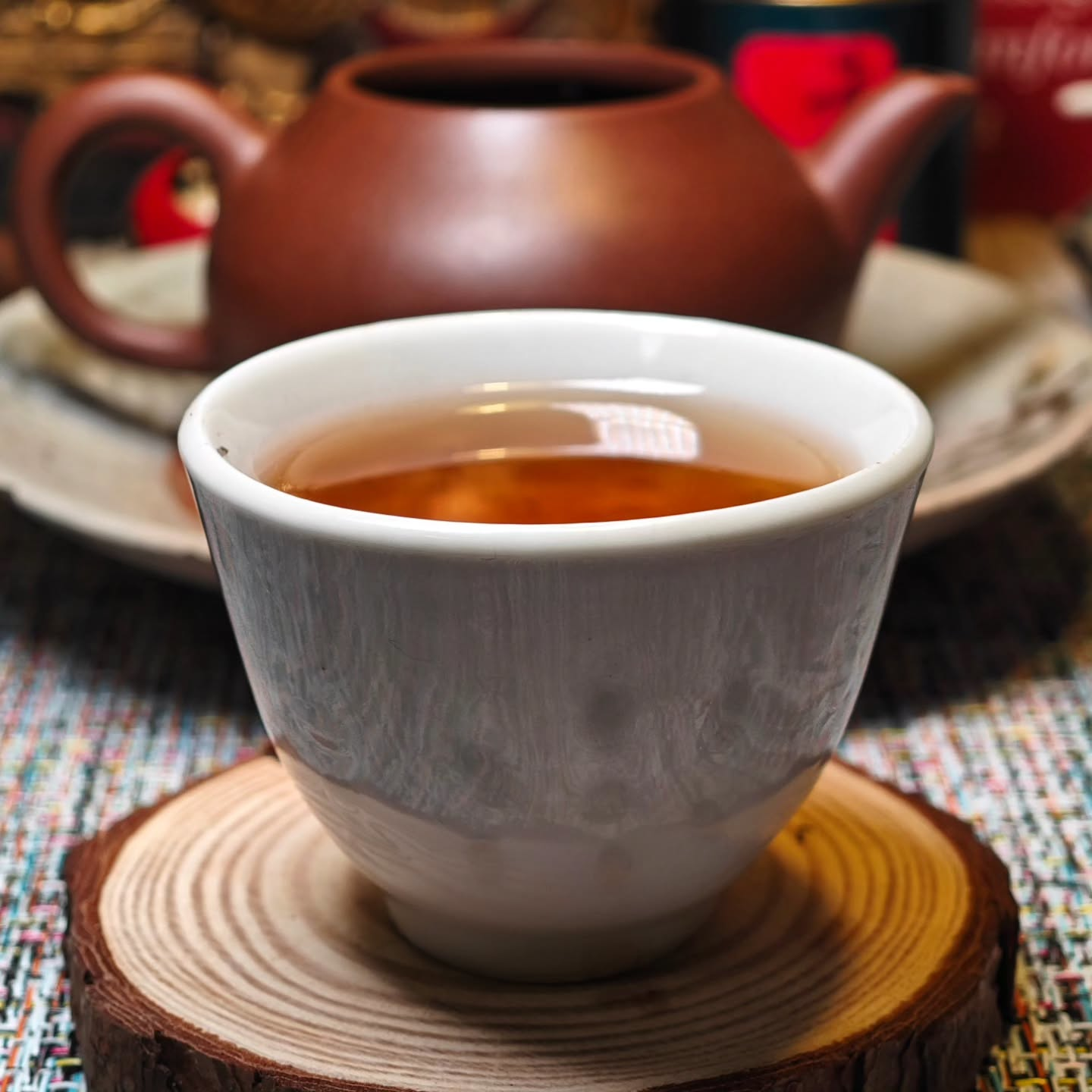
A change in temperament
Ageing is a desired transformation process in some teas, especially those belonging to the post-fermented dark tea variety. When stored correctly, the leaves will continue their post-fermenting during storage. As a result the leaves will gradually gain mellowness, while they loose sharpness and freshness.
In the case of Anhua Dark Tea, the traditional 48 hours pile-fermentation leaves a lot of room for ageing, while also making newly processed tea immediately drinkable and enjoyable. Newly produced Anhua Dark Tea is a finished product with a big ageing potential. Other teas may require a period of storage, until they can be truly enjoyed.
A big misconception, in my mind, is the idea that ageing makes a tea intrinsically better. Ageing cannot improve the quality of the leaves it is made of. It will slowly change a tea’s temperament, not its nature. It is therefore a question of personal preferences, rather than one of absolute superiority.
Not a quality criterion
I personally like to drink older tea later in the day, and when the weather is getting cold. I also very much enjoy the crispness of younger tea. Sometimes this is just what I want. The leaves are somewhat closer to their original state and it reminds me of the mountain they come from.
Aged tea is more expensive, because of its scarcity. I sometimes joke that great aged tea is hard to find, because the good stuff gets enjoyed first. I think there is some truth to that. The older the tea, the more difficult it gets to evaluate its exact age: it sometimes gets repackaged, broken into portions, changes ownership, etc.
Nevertheless, aged tea can be a real treat. I would just advise not to get obsessed with a tea’s age statement. If it procures delicate and mellow sensations, while at the same time letting you feel it was made with great material, everything is looking good!
Outdoor tea
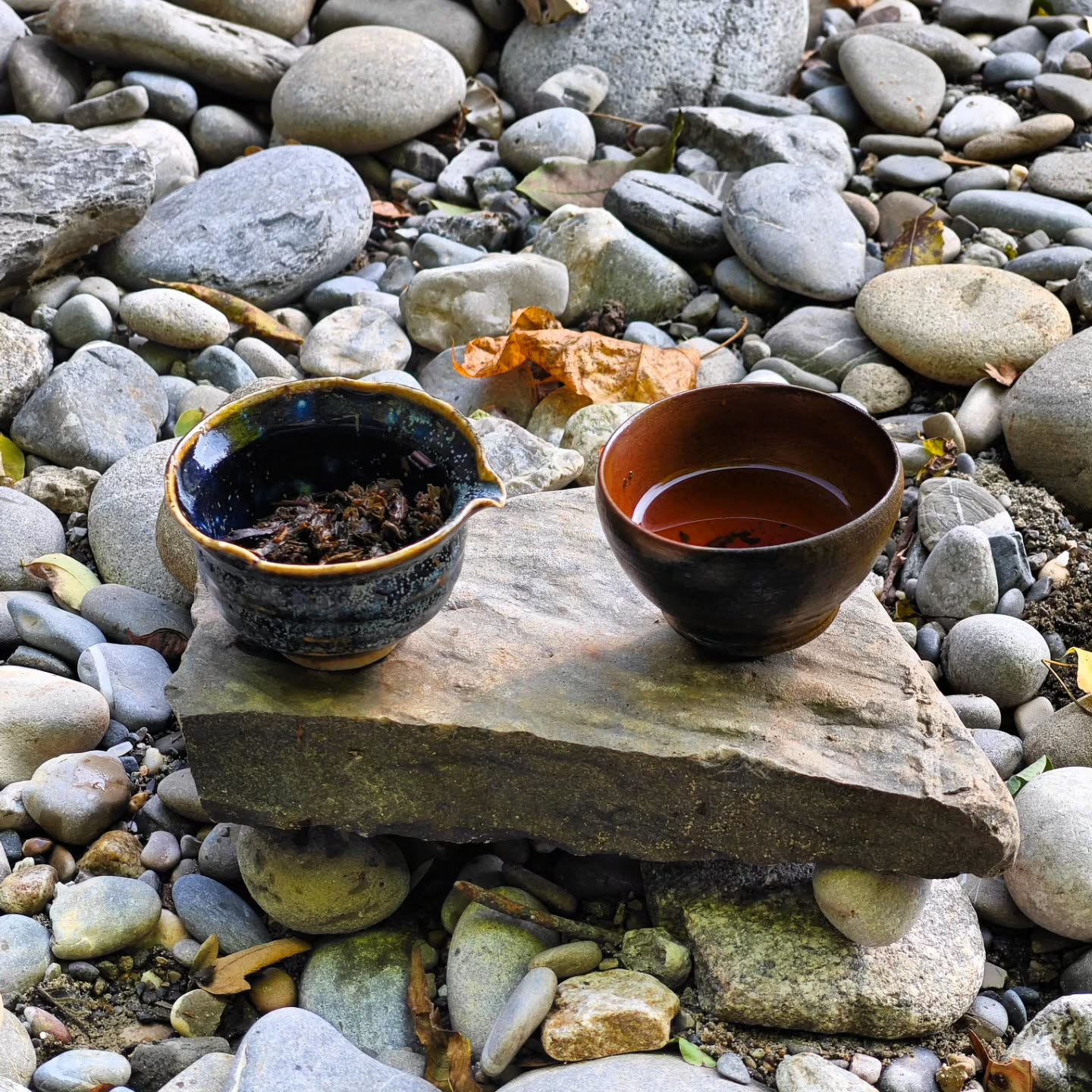
Creating the ideal tea setting
The activity of drinking tea is often considered an indoor ritual. There are good reasons for this. A great part of experiencing tea is about creating an ‘out of time’ experience with the sensations procured by the steeped leaves.
In an indoor setting it is easy to control all the parameters that contribute to such an experience (temperature, lighting, space, tea ware, incense, etc.). This is why tearooms or teahouses are customary places for enjoying tea.
Or stepping outside looking for it
However, anybody who likes to go for a walk knows that it is not unusual to stumble upon little bubbles of Shangri-La here and there, which are perfect backdrops for tasting tea. In fact, many indoor settings attempt to recreate these natural sceneries by hanging paintings depicting them, etc.
Personally, I like to combine my appreciation of tea with my habit of walking. Sometimes I know exactly where I will sit down, while at other times I let the spirit of the place guide me to the nearest ’locus amoenus’.