
The secret behind Anhua Dark Tea’s taste and feeling
While Anhua Dark Tea requires many processing steps, none is as defining as the qixing stove (七星灶) sequence. It is unique to Anhua Dark Tea and all its variations go through it.
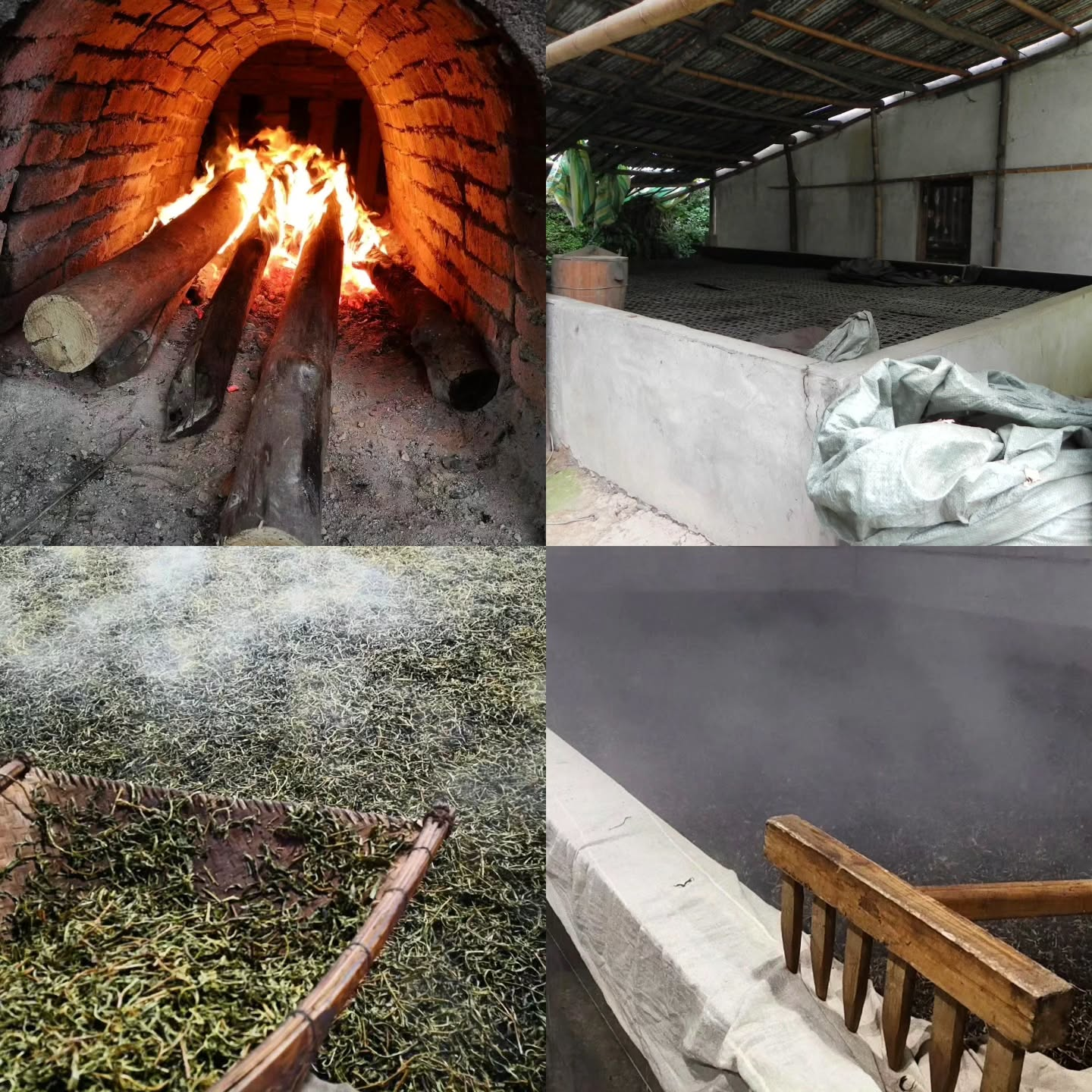
A qixing stove is made of three parts. In the fire pit (1), local pine wood is lit. It is a closed area and sits at one of the extremities of the stove. Holes placed at regular intervals lead the hot air into a large rectangular smoke pit (2), on top of which lies the drying / smoking surface (3), covered with a mat of woven bamboo and a natural linen.
After their light pile-fermentation, the moist tea leaves are kneaded for a second time, which makes them release some water. This is when the qixing stove comes into play. More than just a drying mechanism, it further transforms the leaves and confers to them Anhua Dark Tea’s unique character.
It is on the qixing stove that the alchemy of Anhua Dark Tea takes place. The tea leaves receive their exclusive taste in the coming together of three elements: the leaves’ own essence, the scent of the woven bamboo mat on which they are laid, and the heat and smoke of the pine wood fire.
More than just a tool
Traditionally, both the qixing stove itself and its use were associated with mystical connotations and practices. It is said that it is under the influence of the celestial bodies, and that within it, heaven and earth are blended into the tea leaves, giving Anhua Dark Tea its soul. Its use was reserved for auspicious days.
Qixing literally means seven stars. On the one hand, it refers to the fact that most stoves’ fire pits have seven holes. It is also a direct allusion to the seven stars of the Big Dipper, which plays a central role in Daoism. While its actual shape and appearance is the result of incremental improvements, It can be traced back at least to the Ming Dynasty.
Qixing stoves can be found in tea producing villages as well as in factories. Even the big factories that have a mostly automatized production will maintain a qixing stove for at least some of their products. The simple reason is that tea lovers in Anhua County will tell you that leaves that have not been on a qixing stove cannot be called Anhua Dark Tea.